Most productivity advice is secretly just guilt in a better font. Do more. Wake up earlier. Grind harder. And for a while, it works — until it doesn’t. I’ve had stretches where I was technically “doing everything right” and still felt completely drained, like I was pushing a boulder uphill just to keep up.
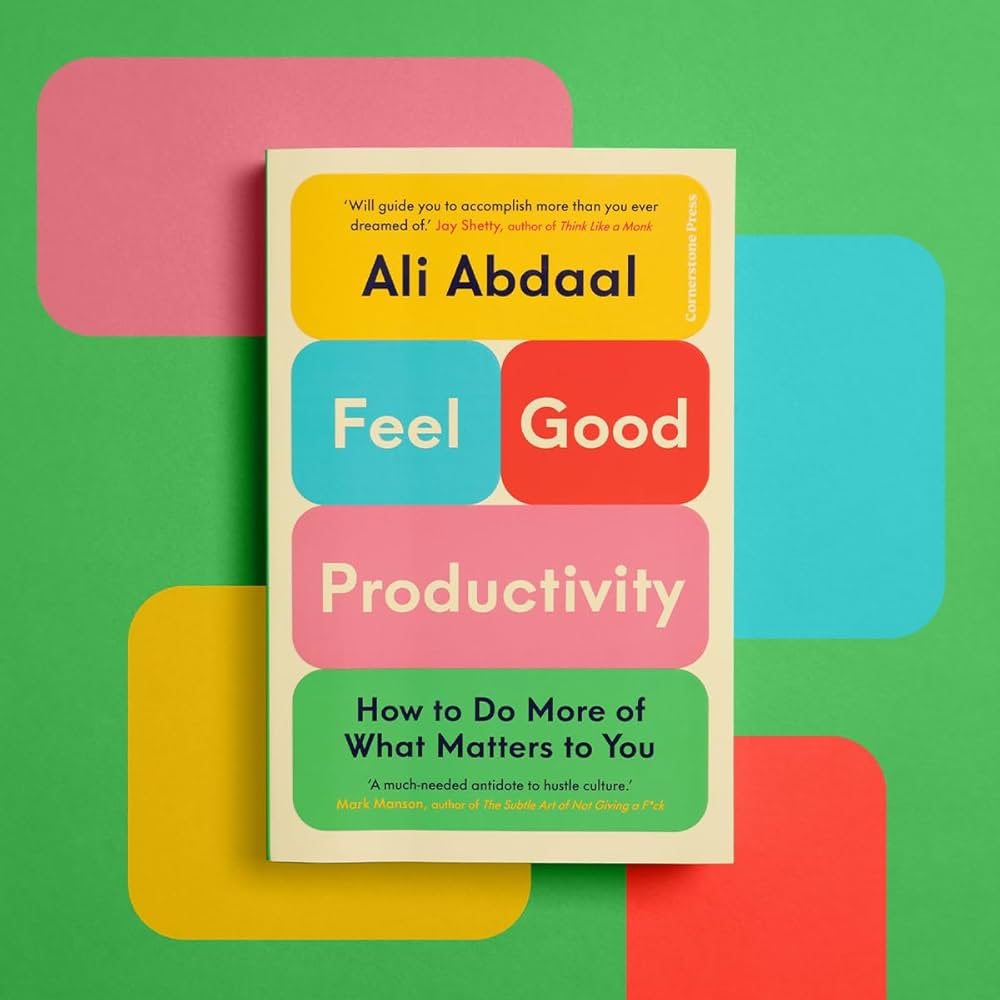
That’s what made Ali Abdaal‘s Feel-Good Productivity land differently for me. The argument at its core is disarmingly simple: feeling good isn’t the reward for being productive — it’s the engine of it. When you feel better, you naturally achieve more. Not because you’re trying harder, but because the resistance is lower.
Who is Ali Abdaal?
Ali is a doctor-turned-creator who built a massive online following while still in medical school. He spent years obsessing over productivity tips and tricks before eventually arriving at a conclusion that cuts against most of the advice in that space: discipline-first thinking is fragile, and mood-first thinking is what actually lasts. If you’re more of a visual learner, his YouTube channel is worth bookmarking — he goes deep into the science behind these ideas and has a way of making dense research feel genuinely watchable. I’ve come back to his videos more than once.
1. Energise: Turning Work into Play
The first section of the book is about energy — specifically, how play is one of the most underrated ways to generate it.
The idea that stuck with me most is deceptively simple: ask yourself, what would this look like if it were fun? Not every task can be made exciting, but most can be made slightly more tolerable with a small shift. One idea I use often is when doing a boring task, have good background music, but nothing with lyrics, he recommends Harry Potter movie scores. Abdaal also talks about confidence not as something you either have or don’t, but as a skill you practise — acting as if you’re confident in a task until the belief catches up with the behaviour. I’ve found this more useful than any pep talk.
He also pushes back on the idea that success is zero-sum. Treating the people around you as teammates rather than competition doesn’t just feel better — it creates a support network that keeps you going when motivation runs dry.
2. Unblock: Overcoming Fear and Inertia
Procrastination, Abdaal argues, is rarely laziness. It’s usually an emotional signal — uncertainty, fear, or just the weight of inertia when you haven’t started yet.
His answer to vague, overwhelming goals is what he calls NICE goals: Near-term, Input-based, Controllable, and Energising. The distinction matters because abstract goals (“get fit,” “finish the project”) give you nowhere to put your energy. Concrete, near-term inputs do.
Two other tools I keep coming back to from this section: the Batman Effect, where you adopt an alter ego to distance yourself from anxiety — Beyoncé famously used “Sasha Fierce” for this — and the five-minute rule, where you commit to just five minutes on something you’ve been avoiding. It sounds too simple, but breaking the initial inertia really is most of the battle.
3. Sustain: Preventing Burnout Through Alignment
The third section is the one I think gets overlooked most in conversations about this book, and it might be the most important.
Abdaal’s point here is that burning out isn’t just about doing too much — it’s often about doing too much of the wrong things. The “Hell Yeah or No” rule is essentially a filter: if you’re not genuinely excited about a commitment, the answer is no. Every yes is a no to something else you actually care about. It’s the same insight at the heart of Greg McKeown’s Essentialism — saying no isn’t about being difficult, it’s about protecting what matters.
He also makes a distinction I found genuinely useful about rest. Not all rest is restorative. The activities that actually recharge you tend to make you feel Competent, Autonomous, Liberated, and Mellow — what he calls the CALM framework. Passively scrolling doesn’t meet that bar. A walk, a creative hobby, or time with people you like usually does.
The section closes with a simple daily practice he calls Alignment Quests — each morning, pick one small action for health, one for work, and one for relationships that moves you toward the life you want a year from now. It’s a way of keeping daily effort connected to something larger than the to-do list.
Think Like a Scientist
The throughline of the whole book is this: there’s no single right way to work, and the people who figure out how to work well treat themselves like an ongoing experiment. Try things. Notice what actually makes you feel better. Adjust.
That framing has changed how I approach my own habits more than any specific tip in the book. If you’ve ever felt like the traditional “push through it” approach to productivity just isn’t sustainable for you, this book makes a compelling case that you’re not wrong — and offers a better way forward. If you want to go even deeper on working sustainably, Cal Newport’s Slow Productivity makes a powerful companion read.
If any of this resonates, I’d genuinely recommend picking up a copy of Feel-Good Productivity. And if you want to go deeper on the science behind it, Ali’s YouTube channel is the place to start. It was the reason I picked up the book in the first place.


Leave a Reply