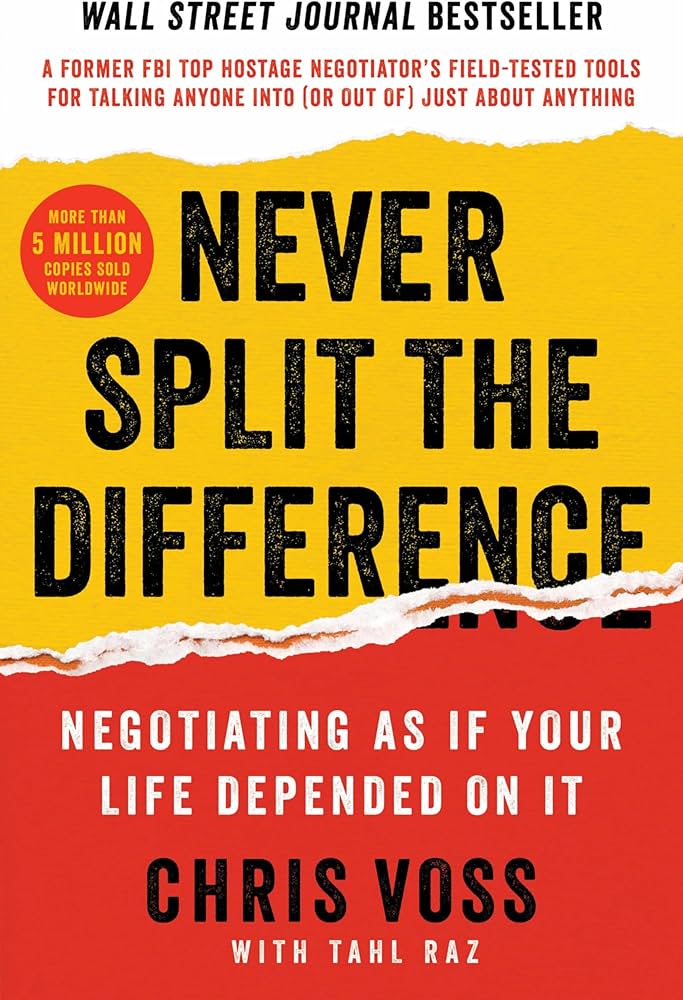
Most people hear “negotiation book” and picture a slick guy in a suit haggling over a car price. That’s not this. Chris Voss spent over two decades as the FBI’s lead international kidnapping negotiator — the person they called when someone’s life was literally on the line. Never Split the Difference is what he learned from that, distilled into something you can actually use at work, at home, and in every conversation where something matters to you.
But here’s the thing: the more I read it, the more I realised this isn’t really a book about getting what you want. It’s a book about becoming someone people actually feel heard by. And that turns out to be the most effective negotiating strategy there is.
The FBI Doesn’t Do “Win-Win”
For years, the gold standard in negotiation was a Harvard framework built on rational problem-solving — separate emotion from the problem, find mutual interests, reach a logical agreement. It’s tidy, sensible, and according to Voss, almost completely wrong.
When FBI negotiators surveyed their own experience, not one of them could recall a situation where calm, rational problem-solving was the right tool. Every single one had dealt with emotionally volatile, high-pressure, deeply irrational situations. Real negotiation — the kind that actually happens between real people — isn’t a logic puzzle. It’s an emotional one.
That’s the foundation the whole book is built on, and once you accept it, everything else follows naturally.
Listening Is the Job
The first and most important tool Voss teaches is something most of us think we already do: listen. We don’t. Not really. What we mostly do is wait for our turn to talk, mentally rehearsing our next point while the other person is still speaking.
Voss calls the alternative tactical empathy — genuinely understanding the feelings and perspective of the other person, and then showing them you understand. Not agreeing with them. Not giving in to them. Just demonstrating that you’ve actually heard what they said. He’s clear that empathy is not sympathy. It’s not about being soft. It’s about being accurate — about understanding the situation as the other person experiences it, so you can actually influence it. It’s about getting the other person to say, “That’s right.” so they know you’re both on the same page.
Psychotherapy research backs this up: when people feel genuinely listened to, they become less defensive, more open, and more willing to consider other points of view. Voss didn’t invent this dynamic — he just figured out how to use it deliberately.
The Tools That Actually Work
The book is full of practical techniques, and a few of them have genuinely stuck with me.
Mirroring is the simplest and probably the most immediately useful. You repeat the last few words of what someone just said back to them. That’s it. It sounds almost too simple to work, but it triggers a natural human instinct to elaborate — people feel heard, they keep talking, and you keep learning. In one study, waiters who mirrored their customers’ orders back to them received 70% more in tips than those who responded with enthusiastic affirmations like “great choice!” Something to think about.
Labelling goes one step further. You name what you think the other person is feeling — “It seems like you’re frustrated with how this has gone” — and let it land. Voss describes this as a shortcut to intimacy. What’s fascinating is the neuroscience behind it: putting a name to an emotion moves brain activity away from the fear-generating amygdala and toward the rational prefrontal cortex. You’re literally calming someone down by acknowledging what they feel, not by telling them not to feel it.
Calibrated questions are open-ended questions — usually starting with “how” or “what” — designed to give the other person the feeling of control while actually guiding the conversation. “How am I supposed to do that?” is Voss’s favourite example. It’s not aggressive. It’s not a demand. But it puts the problem squarely in the other person’s lap and invites them to solve it with you. “How” and “what” do the work. “Why,” Voss warns, almost always sounds like an accusation, in any language.
The “No” Reframe
One of the most counterintuitive ideas in the book is Voss’s argument that “No” is often more valuable than “Yes.” We’ve been conditioned to treat “No” as failure — the door closing, the deal dying. But Voss argues the opposite: “No” gives people a sense of safety and control. It’s a pause, not an ending. It often means “I’m not ready yet” or “I need more information” or “something about this doesn’t feel right.”
Pushing hard for “Yes” makes people defensive. Inviting “No” makes them feel secure enough to actually engage. The negotiation, he says, doesn’t begin until someone says “No.”
And the goal isn’t “Yes” anyway — it’s “That’s right.” That’s the phrase Voss says signals a genuine breakthrough: the moment your counterpart feels so understood that they stop defending their position and start working with you. “You’re right” is what people say to get you to stop talking. “That’s right” is what they say when they actually mean it.
Never Split the Difference (Seriously, Don’t)
The title comes from Voss’s argument against compromise as a default strategy. Splitting the difference sounds fair, but it’s not — it’s lazy. He uses a brilliant image: a woman wants her husband to wear black shoes, he wants to wear brown. They compromise. He wears one of each. Nobody wins. The compromise produced the worst possible outcome.
Real deals, he argues, come from creativity — from understanding what someone actually needs underneath what they’re asking for, and finding a solution that gets you both there. That only happens if you’ve done the work of listening well enough to know what’s really going on.
This Is Really a Book About How to Talk to People
I want to come back to this, because I think it’s easy to pick up Never Split the Difference looking for tactics and miss the bigger point entirely.
What Voss is really teaching is a way of being present with another person. The mirroring, the labelling, the calibrated questions — they only work if you’re genuinely paying attention. You can’t fake tactical empathy any more than you can fake listening. People feel it when you’re not really there.
The skills in this book will make you a better negotiator, yes. But they’ll also make you a better colleague, a better partner, and — honestly — a more interesting person to talk to. Because most people move through conversations focused almost entirely on what they want to say next. Learning to actually hear someone is rarer than it should be, and people notice.
Get the Book
I’ve pulled out the ideas that landed hardest for me, but there’s a lot more in Never Split the Difference that I haven’t touched — the Ackerman bargaining system, Black Swans (the negotiating kind, not the Nassim Taleb kind), how to read liars, and the full framework for preparing for any high-stakes conversation. Voss also tells genuinely gripping stories from his FBI career that make all of this feel real rather than theoretical.
If any of what I’ve covered here resonated with you, the book is absolutely worth your time. It’s one of those rare reads where you finish it and immediately start seeing your conversations differently — not as things that happen to you, but as things you can actually shape. Pick up a copy of Never Split the Difference and see for yourself.