
Category: Mindset & Mastery

  • The Check‑List Effect – Turning Overwhelming Projects into Addictive Progress

    The Check‑List Effect – Turning Overwhelming Projects into Addictive Progress

    Why “Willpower” Isn’t the Engine You Need

    Chris Williamson has talked about the differences between discipline, motivation, and obsession. Discipline takes high effort. Motivation takes some effort. Obsession takes almost none. The takeaway for me: since discipline is expensive, it helps to stack as many small dopamine hits as possible along the way — which is exactly what a good checklist does. The idea is simple: don’t just write down your big, overarching tasks. Break them into small, manageable steps you can actually knock out.

    Willpower is a finite but renewable resource. When I’m handed a very large task, my first instinct is often to see it as too much work — and it’s easy to do nothing instead. Gritting your teeth and forcing it rarely holds up as a long-term strategy.

    What works best for me is taking a task and breaking it down into the smallest measurable output, just to get points on the scoreboard. I’ll take a task, put it on a checklist, and split it into small action items. Every time I cross one off, it’s a small dopamine hit — a point on the scoreboard, a nudge toward the end goal. Those points accumulate, and momentum builds.

    Where the Idea Comes From

    I’d like to say these are my own ideas. They’re not.

    Adam Savage, one of the hosts of MythBusters, wrote a book called Every Tool’s a Hammer, with a whole chapter dedicated to to-do lists. He breaks down taking a big task and splitting it into its smaller steps.

    Admiral William McRaven has a viral commencement speech where he talks about making your bed each morning. Creating a small, guaranteed win proves to yourself that you can follow through, and that builds momentum.

    David Goggins, the retired Navy SEAL, talks a lot about focusing on one task at a time. We’re all easily distracted, and I find the smaller the task, the easier it is to execute. It’s fine to have big dreams and large goals — I just find those are easier to reach once you’ve broken them into small, manageable tasks. Goggins runs a genuinely ridiculous amount, but I’d bet his task list looks something like:

    1. Get out of bed.
    2. Put on running clothes and shoes.
    3. Go outside.
    4. Start running.
    5. Keep going for another 10 seconds.
    6. Repeat step 5 as many times as possible.

    It’s a simple list — brutally hard to execute at his level, but every step on it is manageable.

    James Clear, author of Atomic Habits, writes about small wins compounding into massive results over time. Every small thing crossed off the list is a point on the scoreboard, and every point is one small step closer to the win.

    How to Build Your Do-able To-Do List

    1. Deconstruct Until It Feels Ridiculous

    Take any goal — learning a language, cleaning the garage, writing an article — and keep splitting it until you can say, “I could do that while waiting for my coffee.” If a step still feels big, split it again.

    Example — listing an item on eBay:

    1. Locate the item.
    2. Look up similar sold listings to confirm it’s worth selling.
    3. Take pictures of the item.
    4. Measure weight and dimensions for shipping.
    5. Calculate shipping cost.
    6. Pull up the similar sold listing from step 2 and use it as a template for your own listing.
    7. Upload pictures of the item.
    8. Edit the title and description to fit the item.
    9. Enter the shipping cost.
    10. List the item.

    That’s 10 manageable steps and 10 points on the scoreboard — no “I’m stuck” feeling required.

    2. Keep the List Short & Visible

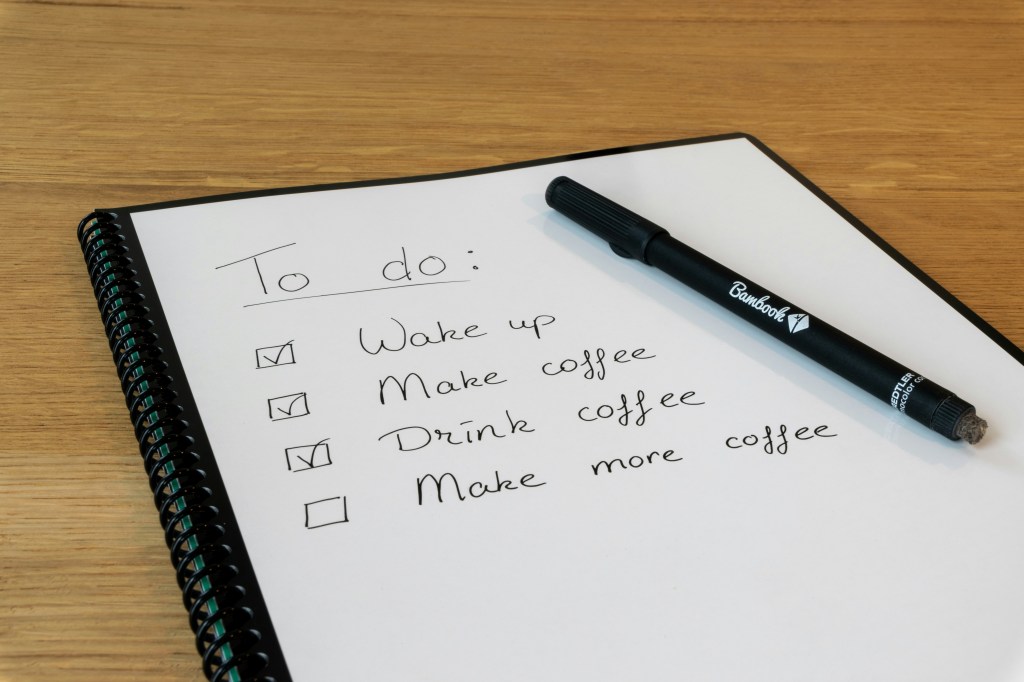
    I like writing my lists physically on paper so I can cross items out easily, and I keep the list on my desk, right next to where I work.

    You could keep a digital list instead, but for me, a list that’s always physically present beats having to open an app or program to check it. Plus, I like being able to physically cross things off.

    3. Cross Off Immediately — The Dopamine Hit

    The moment you cross an item off the list, your brain releases dopamine. That tiny reward tells your subconscious, “We’re making progress.” It’s far more reliable than trying to summon motivation out of thin air.

    4. Batch Identical Micro-Steps (Avoid Task Switching)

    Instead of “weigh item 1 → photograph item 1 → weigh item 2 → photograph item 2,” try “weigh all items” then “photograph all items.” Staying in the same mental mode speeds up each step and cuts down on friction.

    Alternatively, you can batch and still get frequent wins: “weigh item 1 → weigh item 2 → photograph item 1 → photograph item 2.” You keep the efficiency of batching while getting the added dopamine hit of crossing off more items, more often.

    5. Review & Iterate (The “Margin of Mastery”)

    At the end of each day or week, glance at your scoreboard:

    • Which steps consistently took longer than five minutes?
    • Which steps did you breeze through?

    Adjust your future micro-steps accordingly — combine two quick actions into one, or break a stubborn step down further. The data comes from your own progress, not guesswork.

    The Psychology Behind the Points

    1. Progress Principle — Small wins are one of the most powerful motivators for creativity and performance. Every crossed off item is proof of movement, which keeps you coming back to the list.
    2. Compound Effect — Tiny improvements add up exponentially when repeated consistently. A five-minute task today looks trivial, but 20 of them finish a project.
    3. Cognitive Load Theory — Writing tasks down frees up working memory, so you can focus on doing the next step instead of trying to remember it.

    By turning every micro-action into a visible point, you give your brain exactly the feedback loop it craves.

    Final Thought

    Getting big things done usually doesn’t happen with a sudden flash of inspiration. It’s a chain reaction of tiny completions you can see, feel, and measure over a long period of time. By turning every micro-action into an item crossed off your list, you stop fighting your brain and start coaching it. That’s the real trick behind Williamson’s obsession/motivation/discipline framing — obsession works because it doesn’t feel like effort. A checklist gets you closer to the same effortless-feeling momentum, on demand, without needing to be obsessed with anything.

    The result? Projects that once felt impossible become a series of satisfying, repeatable wins — minimal willpower required.

    Give it a try today. Pick one lingering task, slice it into five-minute bites, and watch the scoreboard fill up. Let me know what you think, and if this resonates, feel free to share it with a friend.

  • If You Want to Be Good at Something, Do it for an Unreasonable Amount of Time

    If You Want to Be Good at Something, Do it for an Unreasonable Amount of Time

    Most people who are genuinely good at something don’t look like they’re working that hard.

    The martial artist who casually neutralizes an aggressive attack. The disc golfer who throws 400 feet down a wooded tunnel like it’s nothing. The bartender who runs five tickets at once without breaking a sweat. From the outside, it looks like a gift. From the inside, it’s just a lot of accumulated hours that nobody watched you put in.

    That’s the game. And the entry fee is being willing to be bad at something for long enough that you eventually run out of room to stay bad at it.


    Feed the Hot Coal

    Here’s the thing about passion: it doesn’t wait for you.

    When something new lights you up — a skill, a topic, an idea — that energy is a hot coal. It’s bright, it’s intense, and if you feed it, it can sustain a fire for years. But if you set it down and walk away, it cools. And a cold coal is a lot harder to relight than a hot one is to keep burning.

    This is why when you’re passionate at the beginning of learning anything is actually the most important window. Not because you’re doing it well — you’re not — but because you’re feeding the fire. The passion is there. The curiosity is alive. The worst thing you can do is wait until you feel “ready” to go all in, because by then the coal may have already cooled.

    Embrace the suck while it still excites you. Volume while the fire is burning.


    Do It Badly, at First

    Every skill I’ve ever built started with the same feeling: slow, heavy, and deeply aware of how much I didn’t know.

    In the restaurant, I started as an expeditor on a Friday during the dinner rush. If you’ve never been in a high-volume kitchen mid-service, picture a wall of noise, heat, and tickets — and me just trying not to drown. I wasn’t in any zone. I was just surviving.

    In the homebrew shop, I started as the new guy who was useful primarily because he could move heavy kegs. That was my whole value proposition for a while.

    In martial arts, I was the awkward white belt who telegraphed every move.

    In disc golf, right now, I’m the guy hitting trees on holes I should be navigating cleanly. I record my rounds. I study my form. I throw and it doesn’t look how I want it to look yet.

    The temptation at this stage is to either quit or go looking for a shortcut. A hack, a magic technique, the one drill that will skip the uncomfortable part. There is no such thing. The only move that works is to keep showing up while the coal is hot and let the volume do its job.


    You Will Notice Patterns

    If you stay in the room long enough, the chaos begins to make sense.

    The restaurant kitchen that nearly broke me in week one eventually became readable and eventually easy. I went from Expeditor to prep cook to line cook to server to bartender. Not because someone handed me a promotion — because I kept showing up and paying attention until the whole operation became transparent to me. I became the person they called when someone didn’t show. The Swiss Army knife of the place.

    The homebrew shop followed the same arc. I came in as muscle. Years later, after employees left for better opportunities — I was the person handling purchasing for both kegs and bottles, doing what had previously been two full-time management roles. I saved the owner real money because by that point I had absorbed the supply chains, the supplier relationships, the purchasing rhythms. The work had become systemic in my brain.

    Martial arts did the same thing, just more slowly and more physically. What looks like instinct from the outside is just a brain that has seen the same template — an off-balance hip, a sloppy punch, a telegraphed takedown — enough times that it recognizes the pattern before the conscious mind catches up. I’m not reacting faster. I just know where the movie ends.

    This is the compounding return on volume. You don’t feel it happening. And then one day you realize you’re not fighting the current anymore — you’re reading it.


    The “He’s a Natural” Illusion

    At some point, people start calling you gifted.

    It happened in the restaurant. It happens on the mats. It’ll happen in disc golf eventually — some beginner will watch me throw a clean hyzer around a tree and assume I just have a knack for it. I won’t correct them, but I’ll know what it actually was: a few hundred rounds of hitting that same type of tree and figuring out what I did wrong.

    The “natural” label is almost always just what accumulated competence looks like from the outside when you weren’t there to watch the boring middle part.


    Where I Am Right Now

    I’m at the beginning of something new again — working on getting into data analytics.

    It has that familiar Phase 1 feeling. A lot of information I don’t have yet. A lot of tools I’m still figuring out. The gap between where I am and where I want to be feels wide. But I’ve been here before — in a kitchen, in a keg room, on a mat, on a disc golf course — and I know what the physics of this process actually looks like. The gap closes. It always closes. Not through luck or some sudden breakthrough, but through showing up enough times that staying bad at it becomes unreasonable.

    The coal is hot right now. That’s the whole advantage. So I’m going to feed it.

  • What Learning a Backflip Taught Me About Learning Anything

    What Learning a Backflip Taught Me About Learning Anything

    Most skills worth having are uncomfortable at first.

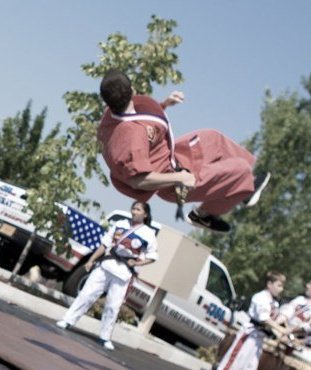
    I was a kid obsessed with tricking — an aesthetic blend of martial arts, gymnastics, and breakdancing. In pursuit of getting better at tricking, a backflip was essential. My trampoline became the training ground, and eventually I developed something that, resembled one — it was a bit more over the shoulder than straight back but it was a start. After a while and a lot of trial and error I got a pretty good looking backflip on the trampoline.

    After building up the courage, the next step was solid ground.

    It did not go well at first. My landings were bad — on all fours — it looked more like a poorly executed back hand spring. After my class ended my parents were waiting to pick me up. I showed them my progress, then asked if I could stay for a bit longer to keep working on it. They said yes, which tells you something about how convincing I was or how patient they were. Either way I stayed an extra two hours working with the sole goal of landing on my feet.

    What followed was a long morning of bad backflips. By the end of the day, I had landed a few of them on my feet, so it was a great success in my book.

    The technique was not textbook. A proper back tuck is about jumping up, tucking, and rotating with your shoulders as the axis. My version involved jumping backward while looking up, throwing my shoulders back, getting minimal height, and rotating around my hips — which works, technically, but is not great. I was young and I was just happy to have landed a few on my feet.

    The next day, it felt like every muscle in my body was sore, and that lasted for about a week.


    What That Day Actually Taught Me

    Almost two decades later, the backflip is still in my muscle memory. So are the lessons from learning it.

    You have to believe it’s possible before you can do it. The first barrier wasn’t physical — it was deciding that this was something my body could actually do. That sounds simple, but it’s real. You cannot commit to a back rotation if part of your brain is still negotiating an exit. Whatever you’re trying to learn, the mental piece comes first. Doubt bleeds into execution.

    When you have an intense burning desire for something, lean into it. I had this desire to learn a backflip. When you stumble upon something new, a skill, a topic, that ignites that same kind of burning passion within you – lean into it. Fuel that fire as long as you can because desires like that don’t last. I could have called it quits after those initial clumsy attempts. I would have eventually learned the backflip, but not with the same speed and intensity. That day, fueled by pure desire, I landed a backflip.

    You have to put in bad reps to get to good ones. There’s a version of “work smarter, not harder” that is actually useful, and a version that is just an excuse not to do the uncomfortable early work. The bad backflips weren’t wasted — they gave me the body awareness to start adjusting. You often need to do the hard work before you know what the smart work looks like.

    Feedback accelerates everything. I didn’t have a coach. I figured it out through trial and error, which worked but was slower and harder on my body than it needed to be. When someone who’s already done what you’re trying to do gives you real feedback, it compresses the timeline significantly. That’s worth seeking out, and in later years I did find a group of like-minded individuals that helped me on my tricking journey.

    Iterations matter more than hours. Naval Ravikant has a line: “It’s not 10,000 hours, it’s 10,000 iterations.” That’s what a two-hour backflip session actually is — not two hours of doing the same thing, but dozens of small experiments and small adjustments. Try something, feel what happened, adjust, go again. The feedback loop is the work.


    The Bottom Line

    The backflip itself wasn’t the point. What stuck with me was the process: identify something you want, accept that the early attempts will be rough, stay in the reps long enough to get real feedback, and keep adjusting until you get it right.

    That applies to most things worth learning.