
Most of us are tracking one number — money — while quietly losing ground everywhere else. Time evaporates. Friendships go into maintenance mode. Health gets deprioritized until it forces its way back onto the list. And the money number, even when it goes up, somehow never feels like enough.
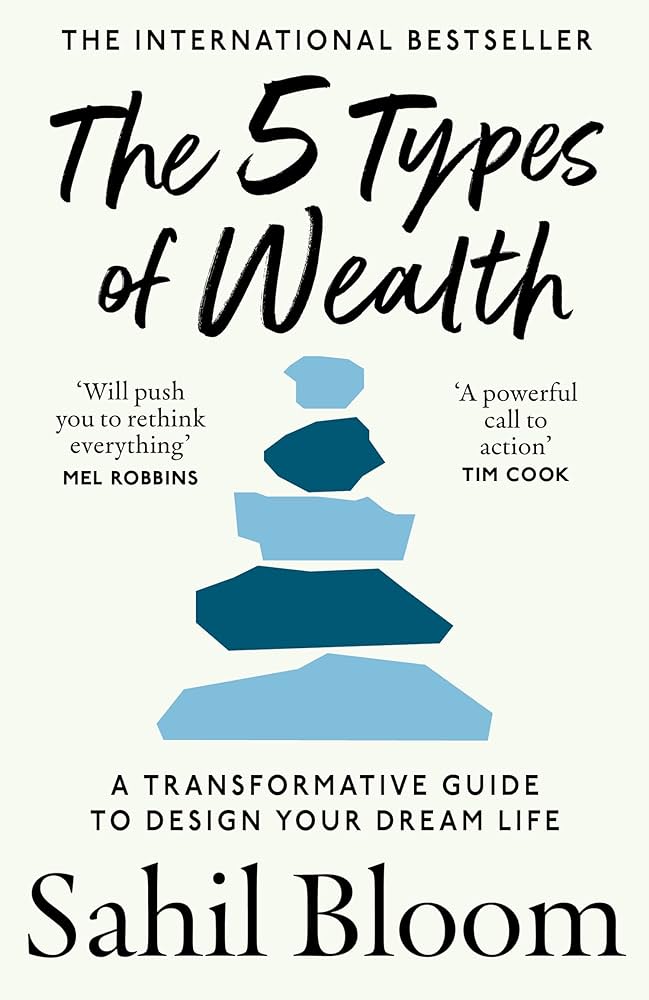
Sahil Bloom’s book The 5 Types of Wealth puts a name to this problem and offers a more useful framework. The argument is simple: financial wealth is one piece of a much larger picture, and optimizing only for it is a good way to win the wrong game.
Here’s how he breaks it down.
Time
This is the one you can’t get back. Bloom points out something genuinely uncomfortable: by the time most of us are adults, we’ve already spent the majority of the time we’ll ever have with our parents and siblings. It’s a rough piece of math. The goal isn’t to have more time — it’s to have control over how you use it.
Relationships
The Harvard Study of Adult Development tracked people for decades and landed on a clear finding: the quality of your relationships is the single biggest predictor of health and happiness as you age. Not income, not status — relationships. Bloom’s useful framing here is the “front-row people” — the ones who show up when it actually matters. Those are the relationships worth protecting.
Mental Wealth
This is about staying curious and having a sense of purpose rather than settling into a comfortable but flat routine. High curiosity correlates with better cognitive health, lower anxiety, and higher life satisfaction. It also means having a growth mindset — believing your abilities are something you develop, not something fixed.
Physical Health
Bloom’s line here is worth keeping: treat your body like a house you have to live in for another seventy years. Exercise is the most powerful single thing we have to slow physical decline. You don’t need a complicated protocol — consistent movement, decent food most of the time, and enough sleep covers most of it.
Money
It’s still in the framework, but it’s in its proper place — as an enabler, not the destination. The useful concept here is defining your “enough” — figuring out what level of financial stability actually lets you live the life you want, instead of just chasing more indefinitely. Lifestyle creep is real, compounding is real, and the gap between the two matters a lot.
The point isn’t that money doesn’t matter. It’s that a life where you’re winning financially but losing everywhere else isn’t actually a win. I’ve seen it and I suspect you have too.
The book goes deeper on each of these with practical exercises for figuring out where you actually stand. Worth reading if this framing resonates with you.

