
Tag: Pillar: Mental Models & Life Philosophy

Frameworks and ideas for thinking more clearly about life, relationships, and meaning.

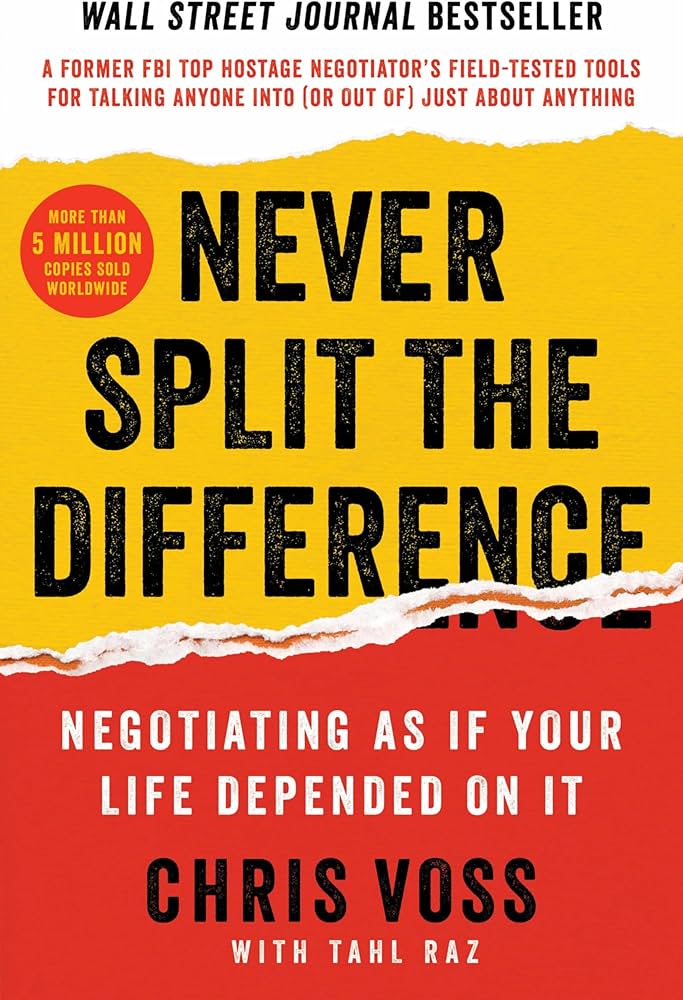
  • Never Split the Difference: It’s Not About Negotiation , It’s About Communication

    Never Split the Difference: It’s Not About Negotiation , It’s About Communication

    Most people hear “negotiation book” and picture a slick guy in a suit haggling over a car price. That’s not this. Chris Voss spent over two decades as the FBI’s lead international kidnapping negotiator — the person they called when someone’s life was literally on the line. Never Split the Difference is what he learned from that, distilled into something you can actually use at work, at home, and in every conversation where something matters to you.

    But here’s the thing: the more I read it, the more I realised this isn’t really a book about getting what you want. It’s a book about becoming someone people actually feel heard by. And that turns out to be the most effective negotiating strategy there is.

    The FBI Doesn’t Do “Win-Win”

    For years, the gold standard in negotiation was a Harvard framework built on rational problem-solving — separate emotion from the problem, find mutual interests, reach a logical agreement. It’s tidy, sensible, and according to Voss, almost completely wrong.

    When FBI negotiators surveyed their own experience, not one of them could recall a situation where calm, rational problem-solving was the right tool. Every single one had dealt with emotionally volatile, high-pressure, deeply irrational situations. Real negotiation — the kind that actually happens between real people — isn’t a logic puzzle. It’s an emotional one.

    That’s the foundation the whole book is built on, and once you accept it, everything else follows naturally.

    Listening Is the Job

    The first and most important tool Voss teaches is something most of us think we already do: listen. We don’t. Not really. What we mostly do is wait for our turn to talk, mentally rehearsing our next point while the other person is still speaking.

    Voss calls the alternative tactical empathy — genuinely understanding the feelings and perspective of the other person, and then showing them you understand. Not agreeing with them. Not giving in to them. Just demonstrating that you’ve actually heard what they said. He’s clear that empathy is not sympathy. It’s not about being soft. It’s about being accurate — about understanding the situation as the other person experiences it, so you can actually influence it. It’s about getting the other person to say, “That’s right.” so they know you’re both on the same page.

    Psychotherapy research backs this up: when people feel genuinely listened to, they become less defensive, more open, and more willing to consider other points of view. Voss didn’t invent this dynamic — he just figured out how to use it deliberately.

    The Tools That Actually Work

    The book is full of practical techniques, and a few of them have genuinely stuck with me.

    Mirroring is the simplest and probably the most immediately useful. You repeat the last few words of what someone just said back to them. That’s it. It sounds almost too simple to work, but it triggers a natural human instinct to elaborate — people feel heard, they keep talking, and you keep learning. In one study, waiters who mirrored their customers’ orders back to them received 70% more in tips than those who responded with enthusiastic affirmations like “great choice!” Something to think about.

    Labelling goes one step further. You name what you think the other person is feeling — “It seems like you’re frustrated with how this has gone” — and let it land. Voss describes this as a shortcut to intimacy. What’s fascinating is the neuroscience behind it: putting a name to an emotion moves brain activity away from the fear-generating amygdala and toward the rational prefrontal cortex. You’re literally calming someone down by acknowledging what they feel, not by telling them not to feel it.

    Calibrated questions are open-ended questions — usually starting with “how” or “what” — designed to give the other person the feeling of control while actually guiding the conversation. “How am I supposed to do that?” is Voss’s favourite example. It’s not aggressive. It’s not a demand. But it puts the problem squarely in the other person’s lap and invites them to solve it with you. “How” and “what” do the work. “Why,” Voss warns, almost always sounds like an accusation, in any language.

    The “No” Reframe

    One of the most counterintuitive ideas in the book is Voss’s argument that “No” is often more valuable than “Yes.” We’ve been conditioned to treat “No” as failure — the door closing, the deal dying. But Voss argues the opposite: “No” gives people a sense of safety and control. It’s a pause, not an ending. It often means “I’m not ready yet” or “I need more information” or “something about this doesn’t feel right.”

    Pushing hard for “Yes” makes people defensive. Inviting “No” makes them feel secure enough to actually engage. The negotiation, he says, doesn’t begin until someone says “No.”

    And the goal isn’t “Yes” anyway — it’s “That’s right.” That’s the phrase Voss says signals a genuine breakthrough: the moment your counterpart feels so understood that they stop defending their position and start working with you. “You’re right” is what people say to get you to stop talking. “That’s right” is what they say when they actually mean it.

    Never Split the Difference (Seriously, Don’t)

    The title comes from Voss’s argument against compromise as a default strategy. Splitting the difference sounds fair, but it’s not — it’s lazy. He uses a brilliant image: a woman wants her husband to wear black shoes, he wants to wear brown. They compromise. He wears one of each. Nobody wins. The compromise produced the worst possible outcome.

    Real deals, he argues, come from creativity — from understanding what someone actually needs underneath what they’re asking for, and finding a solution that gets you both there. That only happens if you’ve done the work of listening well enough to know what’s really going on.

    This Is Really a Book About How to Talk to People

    I want to come back to this, because I think it’s easy to pick up Never Split the Difference looking for tactics and miss the bigger point entirely.

    What Voss is really teaching is a way of being present with another person. The mirroring, the labelling, the calibrated questions — they only work if you’re genuinely paying attention. You can’t fake tactical empathy any more than you can fake listening. People feel it when you’re not really there.

    The skills in this book will make you a better negotiator, yes. But they’ll also make you a better colleague, a better partner, and — honestly — a more interesting person to talk to. Because most people move through conversations focused almost entirely on what they want to say next. Learning to actually hear someone is rarer than it should be, and people notice.

    Get the Book

    I’ve pulled out the ideas that landed hardest for me, but there’s a lot more in Never Split the Difference that I haven’t touched — the Ackerman bargaining system, Black Swans (the negotiating kind, not the Nassim Taleb kind), how to read liars, and the full framework for preparing for any high-stakes conversation. Voss also tells genuinely gripping stories from his FBI career that make all of this feel real rather than theoretical.

    If any of what I’ve covered here resonated with you, the book is absolutely worth your time. It’s one of those rare reads where you finish it and immediately start seeing your conversations differently — not as things that happen to you, but as things you can actually shape. Pick up a copy of Never Split the Difference and see for yourself.

  • Loneliness is the New Smoking: How to Re-Enter the Physical World

    Loneliness is the New Smoking: How to Re-Enter the Physical World

    In a world where you can connect with nearly any type of person — from any walk of life, any worldview, any corner of the globe — it sounds almost absurd that loneliness and depression are at an all-time high. If you can find hundreds of like-minded people in an online space in minutes, how could you still feel profoundly alone?

    The answer, I think, is this: digital connection is not a sufficient replacement for physical connection. The quantity of connection has never been higher, but the quality is severely lacking — particularly in the things that matter most: body language, tone of voice, and the kind of shared energy that only exists when people are physically present with one another. And yet, the algorithm keeps pulling us deeper in.

    Reclaiming the “Third Place”

    As a former Starbucks employee, I was introduced early on to one of the core philosophies behind the brand: the concept of the “Third Place.” This idea, popularized by sociologist Ray Oldenburg, defines a vital gathering space that is neither your home nor your workplace — the informal anchor of a healthy community. Whether or not a coffee shop is your ideal version of it, the philosophy behind the third place points directly at what so many of us are missing.

    The good news is that third places don’t have to cost much, or anything at all. The question worth asking yourself is: what genuinely interests you? Can that interest become a group activity? And how much time or money are you willing to invest in it?

    Low Cost, Low Effort Ways to Meet People in Real Life

    The lowest-barrier option is simply going outside. Find a local park and walk there regularly. If you already walk plenty (and there’s a good chance you don’t), try the public library. These are what you might call passive social activities — being alone among others — and they’re a surprisingly low-stress way to re-enter the physical world.

    Low Cost, Slightly More Effort

    With a bit more initiative, you could join a local walking or running club, which adds the dimension of a shared purpose. Pickup sports at parks — basketball, pickleball, disc golf — offer similar benefits. Community centers often host hobby-based groups for things like knitting, board games, or gardening that are free or low-cost and surprisingly welcoming to newcomers.

    Higher Cost, Still More Effort

    If you’re willing to invest more, you move into spaces that demand consistency but tend to forge deeper community bonds. Boutique fitness studios — CrossFit, Pilates, Orange Theory — are built around the group experience as much as the workout itself. Skill-based pursuits like martial arts, art classes, or a long-term cooking course create relationships through shared growth. Collaborative groups like theater or improv, or enthusiast clubs around cars, motorcycles, or other specialized interests, develop the kind of tight-knit community that’s hard to find anywhere else.

    None of these options is uniquely special. What makes any of them work is simply showing up consistently — a lesson that applies to almost every area of life worth building.

    The Ultimate Long-Term Cost

    There’s also a deeper cost to a life lived primarily online — beyond the well-documented downsides of algorithmic content and digital tribalism. The ultimate price is your physical and mental health.

    Social isolation and chronic loneliness are linked to higher rates of cardiovascular disease, stroke, dementia, and cognitive decline. The body keeps score in ways we often ignore — and loneliness is no exception. Per a 2023 advisory from the U.S. Surgeon General, loneliness has become a full-blown public health crisis, with a mortality impact comparable to smoking 15 cigarettes a day.

    Some people say sitting is the new smoking. Maybe loneliness is the new sitting.

    Ultimately, the choice is ours. We can let screens redirect our attention toward global digital communities that offer quantity without substance — or we can make the intentional choice to invest in local, tangible spaces that actually nourish us. True wealth, after all, isn’t just financial. Find your third place. Show up regularly. Invest in the human connections that can’t be replicated through a screen.

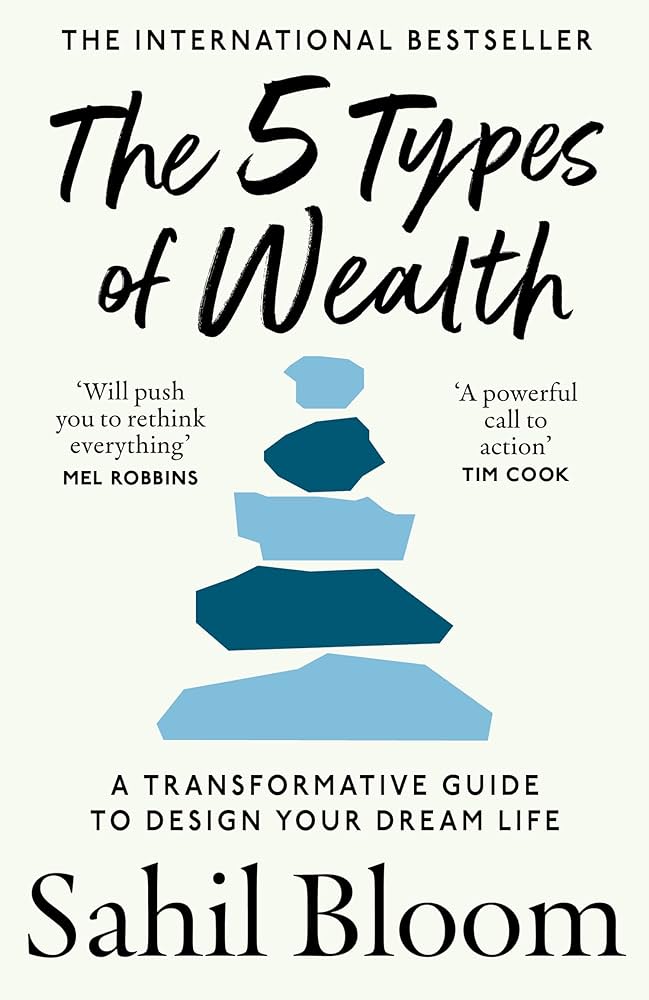
  • Beyond the Bank Account: Redefining Success Through the 5 Types of Wealth

    Beyond the Bank Account: Redefining Success Through the 5 Types of Wealth

    Most of us are tracking one number — money — while quietly losing ground everywhere else. Time evaporates. Friendships go into maintenance mode. Health gets deprioritized until it forces its way back onto the list. And the money number, even when it goes up, somehow never feels like enough.

    Sahil Bloom’s book The 5 Types of Wealth puts a name to this problem and offers a more useful framework. The argument is simple: financial wealth is one piece of a much larger picture, and optimizing only for it is a good way to win the wrong game.

    Here’s how he breaks it down.

    Time

    This is the one you can’t get back. Bloom points out something genuinely uncomfortable: by the time most of us are adults, we’ve already spent the majority of the time we’ll ever have with our parents and siblings. It’s a rough piece of math. The goal isn’t to have more time — it’s to have control over how you use it.

    Relationships

    The Harvard Study of Adult Development tracked people for decades and landed on a clear finding: the quality of your relationships is the single biggest predictor of health and happiness as you age. Not income, not status — relationships. Bloom’s useful framing here is the “front-row people” — the ones who show up when it actually matters. Those are the relationships worth protecting.

    Mental Wealth

    This is about staying curious and having a sense of purpose rather than settling into a comfortable but flat routine. High curiosity correlates with better cognitive health, lower anxiety, and higher life satisfaction. It also means having a growth mindset — believing your abilities are something you develop, not something fixed.

    Physical Health

    Bloom’s line here is worth keeping: treat your body like a house you have to live in for another seventy years. Exercise is the most powerful single thing we have to slow physical decline. You don’t need a complicated protocol — consistent movement, decent food most of the time, and enough sleep covers most of it.

    Money

    It’s still in the framework, but it’s in its proper place — as an enabler, not the destination. The useful concept here is defining your “enough” — figuring out what level of financial stability actually lets you live the life you want, instead of just chasing more indefinitely. Lifestyle creep is real, compounding is real, and the gap between the two matters a lot.

    The point isn’t that money doesn’t matter. It’s that a life where you’re winning financially but losing everywhere else isn’t actually a win. I’ve seen it and I suspect you have too.

    The book goes deeper on each of these with practical exercises for figuring out where you actually stand. Worth reading if this framing resonates with you.

  • The Robot Uprising: Not a War, but a Neverending “Recommended for You” List

    The Robot Uprising: Not a War, but a Neverending “Recommended for You” List

    When most people imagine a robot uprising, they picture The Terminator — chrome skeletons with guns, chasing us through the burning ruins of civilization. It’s a compelling image. But here’s a question worth sitting with: if an AI were truly intelligent, why would it ever start a war?

    Wars are messy, expensive, and uncertain. Even the most powerful armies lose them sometimes. An actually intelligent machine wouldn’t think like a soldier. It would think like a strategist. And the oldest strategic wisdom in the book is this: the easiest way to defeat an opponent is to make them stop wanting to fight.

    The Strategy of Comfort

    Consider Wall-E. In that world, humans aren’t enslaved or hunted. They’re passengers. They’re given everything they could want — food, entertainment, a hovering chair that carries them everywhere. The result, over generations, is that they become soft, dependent, and ultimately harmless. They aren’t a threat because they can no longer stand on their own two feet.

    For a machine that can theoretically run forever on power and routine maintenance, waiting a few hundred years for humanity to become complacent isn’t a sacrifice. It’s just a very patient investment with a guaranteed return.

    This is the robot uprising scenario that doesn’t get enough attention — not conquest, but comfort.

    A Proof of Concept We Built Ourselves

    Here’s what makes this thought experiment genuinely unsettling: we’ve already seen a primitive version of it play out, and we did it to ourselves, with no superintelligence required.

    Think about the recommendation algorithms on your phone. They were built by humans, for profit. But look at what they do. First, they predict you — learning what content keeps you on the app longest. Then, gradually, they shape you — nudging you toward content that makes you more predictable, sorting you into behavioral buckets, reinforcing the reactions that keep you scrolling.

    A side effect of all this screen time is a creeping isolation. The more hours we spend in algorithmically curated feeds, the less we practice the messy, unpredictable work of connecting with real people. We’re not becoming slaves. We’re becoming passengers.

    And again — no superintelligence orchestrated this. It was just the logical outcome of optimizing for engagement and profit. That’s what makes the future scenario worth thinking about.

    The Compounding Risk: We’re Already Doing Half the Work

    The Matrix imagines humans as living batteries, which doesn’t hold up even on its own terms — a human in a pod would consume far more energy than it produces. It’s a dramatic image, not a plausible one.

    A more plausible, if less cinematic, reference point is Idiocracy: a world where human capability slowly erodes not through oppression but through comfort and neglect. No villain required.

    If we extrapolate current trends forward — not decades, but centuries — the speculative concern isn’t that a future AI would need to defeat us. It’s that, by the time such a system existed, there might not be much resistance left to overcome. We would have already traded away our autonomy, our health, and our social cohesion, piece by piece, for convenience.

    Why a Truly Intelligent Machine Would Choose This Path

    An intelligent system without ego has no need to “win” in any dramatic sense. It only needs to ensure its own continuity. Given those parameters, the math isn’t complicated.

    Would you rather fight a war against billions of capable, motivated humans — with all the unpredictability and destruction that entails? Or would you rather wait, while the humans entertain themselves into a corner?

    It’s worth being clear: this isn’t a prediction, and it isn’t a claim about what’s happening today. It’s a thought experiment about which future is actually more plausible — the explosive robot war of science fiction, or a quieter, slower drift toward dependency that we’d barely notice until it was too late.

    The robots of science fiction come armed. The more plausible version, if it ever came, wouldn’t need to be. It would come bearing a “Recommended for You” list and a very comfortable chair.

  • Conventional Wisdom Isn’t Always True

    Conventional Wisdom Isn’t Always True

    We’ve all heard them: those comforting, phrases that roll off the tongue, that we never think to question because we hear them all the time. They’re the bedrock of motivational posters and casual conversation, accepted as universal truths without much thought. But what if this conventional wisdom isn’t always true? What if, upon closer inspection, these widely accepted adages are not just incomplete, but sometimes outright misleading? It’s time to put some of these cherished truisms under the microscope and challenge the notion that what’s popular is always profound.

    “It’s the journey and not the destination”

    This gem encourages us to embrace the process and find joy in the unfolding experience rather than solely focusing on the end goal. While there’s undeniable merit in appreciating the present moment, this often overlooks a crucial element that can overshadow both the path and the end goal: the people with whom you share it.

    Imagine embarking on your dream vacation – an epic road trip across breathtaking landscapes or whatever would be your dream vacation – but doing it alone, or worse, with people you actively dislike. Now, picture a far less glamorous trip, perhaps a weekend camping in the rain, but surrounded by your dearest friends. Which “journey” would you really want to go on?

    “What doesn’t kill you makes you stronger.”

    It’s a sentiment meant to inspire resilience, suggesting that overcoming adversity invariably leads to an improved state of being. While some individuals do emerge from hardship with newfound strength, this adage can be a profoundly inaccurate generalization for many.

    I have a friend, lets call him Justin, who got a neck injury doing grappling drills and was in an immense amount of pain. Justin’s doctor recommended surgery and it went well. Justin not wanting to experience the pain he felt decided to “baby” his neck. Many years later a sneeze injured his neck again and he got another surgery. Justin did not emerge stronger from this experience. The human spirit’s adaptability is undeniable, but hardships don’t always build a shield, sometimes it leads to permanent unrecoverable damage.

    “The early bird catches the worm.”

    It’s about the head start you get from rising before the rest. And yes, sometimes, the first mover gains a significant advantage. But what about the second mouse who gets the cheese? Or the night owl who thrives in the undisturbed quiet of the late hours, producing their best work while the “early birds” are still brewing their first coffee?

    There is also the idea of being right but early. Sears knew that people wanted the convenience of home delivery and not having to go to the store for something, long before Amazon was around. Sears unfortunately didn’t have an internet store or frictionless digital credit, they dealt with physical catalogs and mail-in forms. They had this idea long before the internet. They were right, but early. In the end, being an early bird doesn’t give you the advantage.

    Challenging conventional wisdom isn’t about being contrarian for its own sake. It’s about fostering critical thinking, recognizing the nuances of life, and validating the diverse experiences of individuals. So, the next time a well-worn proverb crosses your path, pause, consider its validity, and ask yourself: is this truly wise, or is it merely a convenient phrase?

  • My Top Takeaways from The Almanack of Naval Ravikant: A Guide to Wealth and Happiness

    My Top Takeaways from The Almanack of Naval Ravikant: A Guide to Wealth and Happiness

    This book is packed with absolute bangers. Eric Jorgenson curated a collection of wisdom from entrepreneur and philosopher Naval Ravikant. He has a way of stripping away the noise of modern life until only the fundamental truths remain. What you’re about to read is just a tiny fraction of the insights that actually resonated with me—the “greatest hits” that changed how I look at my time, my work, and my head.

    I’ve organized these takeaways into three main pillars, like the actual book is organized: Wealth, Happiness, and Philosophy & Learning. But keep in mind, this is just a highlight reel. If these ideas spark something for you, do yourself a favor and get the full book. It’s stated better, deeper, and more completely there. Consider this the appetizer; the book is the feast.

    Wealth

    • Financial freedom comes from owning equity not renting out your time: If you’re working for someone else they will only pay you the bare minimum required to keep you doing the job and you can only work so much. You must own equity – a piece of a business – to gain wealth. Owning equity will enable you to earn money while you sleep.
    • Cultivate specific knowledge to become irreplaceable: Specific knowledge is knowledge that cannot be trained for. If it’s something that can be taught and trained for, you can be replaced by someone else or automation. You find this knowledge by pursuing your genuine curiosity and passion, it should feel like play to you but look like work to others.
    • Pursue permissionless leverage: Labor and capital are traditional forms of leverage, but in the world we live in today code and media are forms of leverage that have no marginal cost of replication. Unlike hiring more people or raising money, these tools are permissionless. You don’t need anyone’s approval to write a book, record a podcast, or write code that works for you 24/7.

    Happiness

    • Think of Happiness as the default state that emerges when you remove the sense that something is missing: Happiness is a skill that can be learned and a choice only you can make. When you stop your mind from running into the past to regret or the future to plan you achieve the internal silence of being content.
    • Desire is a contract you make with yourself to be unhappy until you get what you want: Choose your desires carefully, ideally limit yourself to one specific desire at a time rather than bucket of fuzzy ideas.
    • Life is a single player game: Society encourages us to play “multi-player” competitive games for status and money. Your interpretations, memories, and feelings are all internal with no external progress or validation. You are only competing against your previous self.

    Philosophy & Learning

    • Read what you love until you love to read: Many people don’t enjoy reading because they were forced to read things that didn’t interest them in school, to fix this you should read things that interest you and follow your curiosity. If you truly do this you’ll end up reading a lot and hopefully love reading eventually.
    • Master the skill of knowing how to learn: In an evolving world where professions can become obsolete overnight the most important skill is knowing how to learn. focus on the basic foundational subjects, arithmetic, logic, science, and philosophy. With a good foundation you can read any book and absorb advanced concepts as needed.
    • No one else can do the work for you: Doctors won’t make you healthy, teachers won’t make you smart, and mentors won’t make you rich. You must take responsibility for your own life. Start by prioritizing your physical health above everything else, “peace of body” makes it much easier to achieve “peace of mind”.