
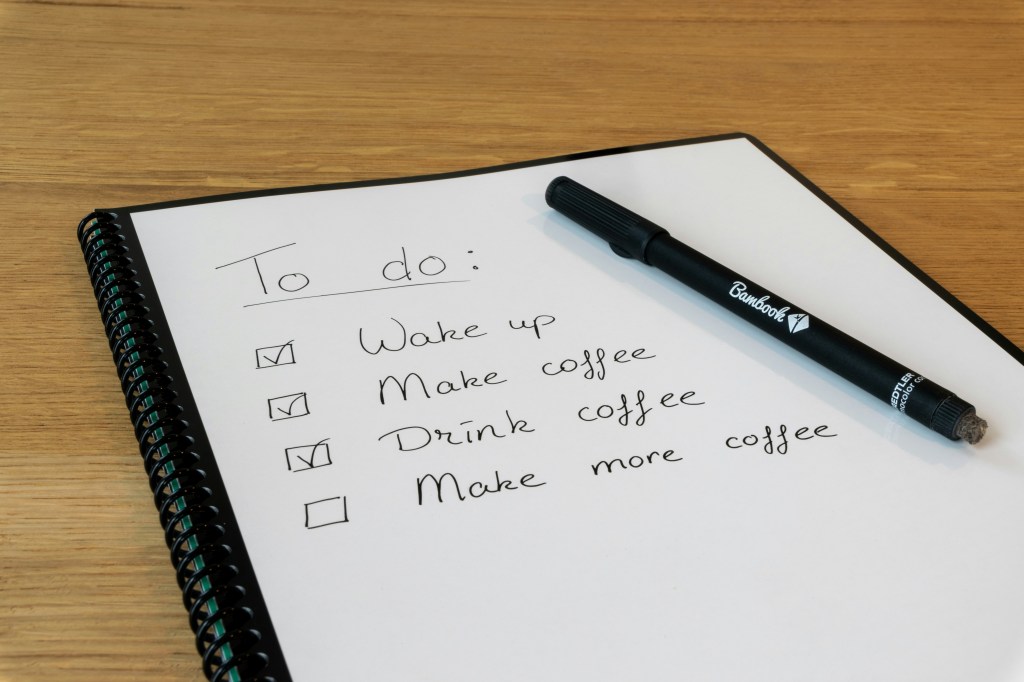
Why “Willpower” Isn’t the Engine You Need
Chris Williamson has talked about the differences between discipline, motivation, and obsession. Discipline takes high effort. Motivation takes some effort. Obsession takes almost none. The takeaway for me: since discipline is expensive, it helps to stack as many small dopamine hits as possible along the way — which is exactly what a good checklist does. The idea is simple: don’t just write down your big, overarching tasks. Break them into small, manageable steps you can actually knock out.
Willpower is a finite but renewable resource. When I’m handed a very large task, my first instinct is often to see it as too much work — and it’s easy to do nothing instead. Gritting your teeth and forcing it rarely holds up as a long-term strategy.
What works best for me is taking a task and breaking it down into the smallest measurable output, just to get points on the scoreboard. I’ll take a task, put it on a checklist, and split it into small action items. Every time I cross one off, it’s a small dopamine hit — a point on the scoreboard, a nudge toward the end goal. Those points accumulate, and momentum builds.
Where the Idea Comes From
I’d like to say these are my own ideas. They’re not.
Adam Savage, one of the hosts of MythBusters, wrote a book called Every Tool’s a Hammer, with a whole chapter dedicated to to-do lists. He breaks down taking a big task and splitting it into its smaller steps.
Admiral William McRaven has a viral commencement speech where he talks about making your bed each morning. Creating a small, guaranteed win proves to yourself that you can follow through, and that builds momentum.
David Goggins, the retired Navy SEAL, talks a lot about focusing on one task at a time. We’re all easily distracted, and I find the smaller the task, the easier it is to execute. It’s fine to have big dreams and large goals — I just find those are easier to reach once you’ve broken them into small, manageable tasks. Goggins runs a genuinely ridiculous amount, but I’d bet his task list looks something like:
- Get out of bed.
- Put on running clothes and shoes.
- Go outside.
- Start running.
- Keep going for another 10 seconds.
- Repeat step 5 as many times as possible.
It’s a simple list — brutally hard to execute at his level, but every step on it is manageable.
James Clear, author of Atomic Habits, writes about small wins compounding into massive results over time. Every small thing crossed off the list is a point on the scoreboard, and every point is one small step closer to the win.
How to Build Your Do-able To-Do List
1. Deconstruct Until It Feels Ridiculous
Take any goal — learning a language, cleaning the garage, writing an article — and keep splitting it until you can say, “I could do that while waiting for my coffee.” If a step still feels big, split it again.
Example — listing an item on eBay:
- Locate the item.
- Look up similar sold listings to confirm it’s worth selling.
- Take pictures of the item.
- Measure weight and dimensions for shipping.
- Calculate shipping cost.
- Pull up the similar sold listing from step 2 and use it as a template for your own listing.
- Upload pictures of the item.
- Edit the title and description to fit the item.
- Enter the shipping cost.
- List the item.
That’s 10 manageable steps and 10 points on the scoreboard — no “I’m stuck” feeling required.
2. Keep the List Short & Visible
I like writing my lists physically on paper so I can cross items out easily, and I keep the list on my desk, right next to where I work.
You could keep a digital list instead, but for me, a list that’s always physically present beats having to open an app or program to check it. Plus, I like being able to physically cross things off.
3. Cross Off Immediately — The Dopamine Hit
The moment you cross an item off the list, your brain releases dopamine. That tiny reward tells your subconscious, “We’re making progress.” It’s far more reliable than trying to summon motivation out of thin air.
4. Batch Identical Micro-Steps (Avoid Task Switching)
Instead of “weigh item 1 → photograph item 1 → weigh item 2 → photograph item 2,” try “weigh all items” then “photograph all items.” Staying in the same mental mode speeds up each step and cuts down on friction.
Alternatively, you can batch and still get frequent wins: “weigh item 1 → weigh item 2 → photograph item 1 → photograph item 2.” You keep the efficiency of batching while getting the added dopamine hit of crossing off more items, more often.
5. Review & Iterate (The “Margin of Mastery”)
At the end of each day or week, glance at your scoreboard:
- Which steps consistently took longer than five minutes?
- Which steps did you breeze through?
Adjust your future micro-steps accordingly — combine two quick actions into one, or break a stubborn step down further. The data comes from your own progress, not guesswork.
The Psychology Behind the Points
- Progress Principle — Small wins are one of the most powerful motivators for creativity and performance. Every crossed off item is proof of movement, which keeps you coming back to the list.
- Compound Effect — Tiny improvements add up exponentially when repeated consistently. A five-minute task today looks trivial, but 20 of them finish a project.
- Cognitive Load Theory — Writing tasks down frees up working memory, so you can focus on doing the next step instead of trying to remember it.
By turning every micro-action into a visible point, you give your brain exactly the feedback loop it craves.
Final Thought
Getting big things done usually doesn’t happen with a sudden flash of inspiration. It’s a chain reaction of tiny completions you can see, feel, and measure over a long period of time. By turning every micro-action into an item crossed off your list, you stop fighting your brain and start coaching it. That’s the real trick behind Williamson’s obsession/motivation/discipline framing — obsession works because it doesn’t feel like effort. A checklist gets you closer to the same effortless-feeling momentum, on demand, without needing to be obsessed with anything.
The result? Projects that once felt impossible become a series of satisfying, repeatable wins — minimal willpower required.
Give it a try today. Pick one lingering task, slice it into five-minute bites, and watch the scoreboard fill up. Let me know what you think, and if this resonates, feel free to share it with a friend.

