
Tag: personal-growth

  • If You Want to Be Good at Something, Do it for an Unreasonable Amount of Time

    If You Want to Be Good at Something, Do it for an Unreasonable Amount of Time

    Most people who are genuinely good at something don’t look like they’re working that hard.

    The martial artist who casually neutralizes an aggressive attack. The disc golfer who throws 400 feet down a wooded tunnel like it’s nothing. The bartender who runs five tickets at once without breaking a sweat. From the outside, it looks like a gift. From the inside, it’s just a lot of accumulated hours that nobody watched you put in.

    That’s the game. And the entry fee is being willing to be bad at something for long enough that you eventually run out of room to stay bad at it.


    Feed the Hot Coal

    Here’s the thing about passion: it doesn’t wait for you.

    When something new lights you up — a skill, a topic, an idea — that energy is a hot coal. It’s bright, it’s intense, and if you feed it, it can sustain a fire for years. But if you set it down and walk away, it cools. And a cold coal is a lot harder to relight than a hot one is to keep burning.

    This is why when you’re passionate at the beginning of learning anything is actually the most important window. Not because you’re doing it well — you’re not — but because you’re feeding the fire. The passion is there. The curiosity is alive. The worst thing you can do is wait until you feel “ready” to go all in, because by then the coal may have already cooled.

    Embrace the suck while it still excites you. Volume while the fire is burning.


    Do It Badly, at First

    Every skill I’ve ever built started with the same feeling: slow, heavy, and deeply aware of how much I didn’t know.

    In the restaurant, I started as an expeditor on a Friday during the dinner rush. If you’ve never been in a high-volume kitchen mid-service, picture a wall of noise, heat, and tickets — and me just trying not to drown. I wasn’t in any zone. I was just surviving.

    In the homebrew shop, I started as the new guy who was useful primarily because he could move heavy kegs. That was my whole value proposition for a while.

    In martial arts, I was the awkward white belt who telegraphed every move.

    In disc golf, right now, I’m the guy hitting trees on holes I should be navigating cleanly. I record my rounds. I study my form. I throw and it doesn’t look how I want it to look yet.

    The temptation at this stage is to either quit or go looking for a shortcut. A hack, a magic technique, the one drill that will skip the uncomfortable part. There is no such thing. The only move that works is to keep showing up while the coal is hot and let the volume do its job.


    You Will Notice Patterns

    If you stay in the room long enough, the chaos begins to make sense.

    The restaurant kitchen that nearly broke me in week one eventually became readable and eventually easy. I went from Expeditor to prep cook to line cook to server to bartender. Not because someone handed me a promotion — because I kept showing up and paying attention until the whole operation became transparent to me. I became the person they called when someone didn’t show. The Swiss Army knife of the place.

    The homebrew shop followed the same arc. I came in as muscle. Years later, after employees left for better opportunities — I was the person handling purchasing for both kegs and bottles, doing what had previously been two full-time management roles. I saved the owner real money because by that point I had absorbed the supply chains, the supplier relationships, the purchasing rhythms. The work had become systemic in my brain.

    Martial arts did the same thing, just more slowly and more physically. What looks like instinct from the outside is just a brain that has seen the same template — an off-balance hip, a sloppy punch, a telegraphed takedown — enough times that it recognizes the pattern before the conscious mind catches up. I’m not reacting faster. I just know where the movie ends.

    This is the compounding return on volume. You don’t feel it happening. And then one day you realize you’re not fighting the current anymore — you’re reading it.


    The “He’s a Natural” Illusion

    At some point, people start calling you gifted.

    It happened in the restaurant. It happens on the mats. It’ll happen in disc golf eventually — some beginner will watch me throw a clean hyzer around a tree and assume I just have a knack for it. I won’t correct them, but I’ll know what it actually was: a few hundred rounds of hitting that same type of tree and figuring out what I did wrong.

    The “natural” label is almost always just what accumulated competence looks like from the outside when you weren’t there to watch the boring middle part.


    Where I Am Right Now

    I’m at the beginning of something new again — working on getting into data analytics.

    It has that familiar Phase 1 feeling. A lot of information I don’t have yet. A lot of tools I’m still figuring out. The gap between where I am and where I want to be feels wide. But I’ve been here before — in a kitchen, in a keg room, on a mat, on a disc golf course — and I know what the physics of this process actually looks like. The gap closes. It always closes. Not through luck or some sudden breakthrough, but through showing up enough times that staying bad at it becomes unreasonable.

    The coal is hot right now. That’s the whole advantage. So I’m going to feed it.

  • The Antidote to Burnout: Finding Meaning in Slow Productivity

    The Antidote to Burnout: Finding Meaning in Slow Productivity

    If you’ve ever ended a packed workday feeling like you somehow got nothing done, you’re not imagining things. The modern workplace keeps raising the bar — more emails, more meetings, more pings — while the actual meaningful work keeps getting squeezed out. Cal Newport’s book Slow Productivity is a direct response to that problem. It lays out a practical philosophy for getting important things done without running yourself into the ground. Here’s a look at the ideas that matter most.

    A quiet workspace representing slow, intentional productivity

    The Problem: Busyness Isn’t the Same as Productivity

    One of the most useful ideas in the book is the concept of “pseudo-productivity” — the habit of using visible busyness as a stand-in for actual results. Because knowledge work is hard to measure, we often default to the things that look like work: answering emails quickly, keeping our calendars full, always being “on.”

    The problem is that all of this activity gets in the way of the deeper, more focused work that actually moves things forward. Newport calls it “jittery busyness” — and argues that escaping it is the first step toward doing work that genuinely matters. It’s the same trap that Ali Abdaal tackles in Feel-Good Productivity — the idea that looking busy and actually producing something meaningful are very different things.

    Principle 1: Do Fewer Things

    The first principle sounds almost too simple: cut down on your commitments until you can actually imagine finishing them. Newport’s argument is that when your plate is overflowing, everything suffers — you’re always context-switching, nothing gets your full attention, and the quality of your work drops. By focusing on a small number of projects that genuinely matter, you paradoxically get more done in the long run.

    One practical tool Newport suggests is this simple system for managing requests:

    ·The Holding Tank: When a new project request comes in, it goes on a list — no commitment yet, just a place to park it.

    ·The Active List: You work on no more than three projects at a time. That’s it.

    ·The Pull System: When one project wraps up, you pull the next one from the holding tank. Not before.

    ·Be Transparent: Let colleagues know roughly where their request sits in the queue and when you realistically expect to get to it.

    This system won’t win you any “most responsive” awards, but it’s the kind of structure that lets you actually do good work instead of just staying busy. It pairs well with the thinking in Greg McKeown’s Essentialism — both books make the case that protecting your attention is one of the most important things you can do.

    Principle 2: Work at a Sustainable Pace

    Newport’s second principle pushes back against the idea that grinding harder is always the answer. He argues that working at full intensity all the time is not natural — and not sustainable. Think of how seasons work in nature: periods of high activity followed by rest. Our best work tends to happen when we build that kind of rhythm into our lives.

    A simple but surprisingly powerful suggestion: double your timeline estimates. If you think a project will take two weeks, budget a month. This isn’t about lowering your standards — it’s about being honest with yourself and creating space for the kind of careful, thoughtful work that leads to results you’re proud of.

    Newport also makes a case for building small breaks into your routine — a Monday with no meetings, or an occasional afternoon away from your desk. These aren’t indulgences. They’re what it takes to keep your brain from getting stuck in a reactive loop where you’re always putting out fires instead of making real progress.

    Principle 3: Care Deeply About Quality

    The third principle is about raising your own bar — not in the sense of working more hours, but in caring genuinely about how good your work is. When you’re truly committed to producing something excellent, busyness starts to feel like what it is: a threat to the thing you care about. Saying no becomes easier. Cutting shallow commitments becomes easier. Quality becomes its own filter.

    Think of a craftsperson who takes pride in their work. They don’t rush a piece just because someone’s asking. They know that the reputation they build through consistently excellent work is worth more than any short-term win they’d get from saying yes to everything. Newport argues the same logic applies in knowledge work. Over time, doing fewer things — but doing them really well — earns you more professional freedom, not less.

    A Different Kind of Success

    Slow Productivity isn’t a book about doing less for its own sake. It’s about stepping off the treadmill long enough to ask: is all this activity actually getting me anywhere? Newport’s answer is that where you end up matters more than how fast you run. By steadily putting in meaningful effort — rather than constantly reacting and scrambling — you can build a body of work you’re proud of, without burning out along the way. That kind of intentionality extends beyond work too — it’s the same reframe behind Sahil Bloom’s 5 Types of Wealth: success means more than one number going up.

    If any of this rings true for how you’ve been feeling about your work, the book is well worth a read. It’s full of concrete strategies and real-world examples that make these ideas easy to start putting into practice.

  • The Disciplined Pursuit of Less… But Better

    The Disciplined Pursuit of Less… But Better

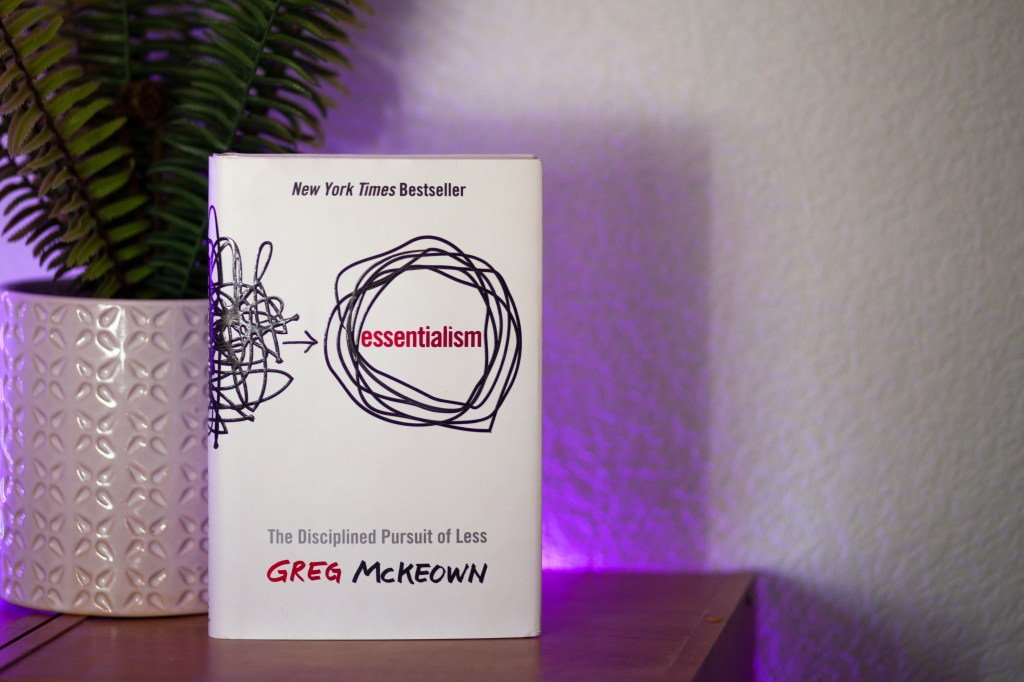
    In a world that constantly pulls at our time, energy, and attention, Greg McKeown’s Essentialism offers a simple but powerful idea: do less, but do it better. The book isn’t about cramming more into your day — it’s about doing only the right things so you can give them the time and focus they deserve. Here are the themes that stuck with me most.

    You Always Have a Choice

    One of the biggest wake-up calls in the book is this: choice is something we do, not something that just happens to us. When we stop owning our choices, we slowly hand control of our lives over to other people’s priorities. The bottom line? If you don’t decide what matters most in your life, someone else will do it for you. A simple mindset shift — from “I have to” to “I choose to” — can be the first step toward a life that actually feels like yours.

    Why Success Can Work Against You

    McKeown describes what he calls the “Success Paradox,” and it’s surprisingly easy to relate to. When you do well, people notice. You become the go-to person, and more opportunities start coming your way. Sounds great, right? But here’s the catch — those opportunities are really just more demands on your time. Before long, you’re stretched so thin that you can’t do anything well, including the thing that made you successful in the first place. Cal Newport calls this same trap “jittery busyness” in Slow Productivity — worth reading alongside this one.

    Saying Yes to Less

    Not every opportunity is worth your time. In fact, most aren’t. The book argues that only a small handful of choices will ever truly move the needle in your life. To find those, McKeown suggests a simple gut-check: if an opportunity doesn’t feel like a clear, enthusiastic “yes,” treat it as a “no.” A good rule of thumb he offers — if you wouldn’t rate it 90% or higher, rate it zero and walk away.

    Getting Good at Saying No

    Saying yes to what matters means getting comfortable saying no to what doesn’t. The book compares this to editing a film — a great editor doesn’t just cut bad footage, they cut anything that doesn’t make the story stronger. The same goes for your life. Trimming the non-essentials isn’t about being selfish or harsh; it’s about making room for the people and goals that matter most to you. Ali Abdaal makes a nearly identical point in Feel-Good Productivity — his “Hell Yeah or No” rule is Essentialism in a different frame.

    Take Care of Your Most Important Tool — You

    McKeown makes a strong case that your most valuable asset isn’t your job, your network, or your skills — it’s you. And the most basic way to protect that asset is often the most overlooked: sleep. Getting enough rest isn’t a sign of laziness. It’s what keeps your mind sharp and your creativity alive so you can actually show up at your best.

    A Life That Feels Worth It

    At its heart, Essentialism is about avoiding the trap of being busy but never feeling fulfilled. By getting clear on what truly matters — and cutting out everything that doesn’t — you can stop just going through the motions and start building a life with real meaning and joy in it. If that bigger-picture reframe resonates, Sahil Bloom’s 5 Types of Wealth takes it even further — arguing that financial success is just one of five areas that actually make a life feel full.

    There are plenty more insights packed into this book, and I’d absolutely recommend picking it up if any of this clicked for you.